
×
Empowering India, One Digital Payment at a Time! #IndiaPaysDigitally #HarPaymentDigital
Know more
Beyond Accounts: Offering cards, loans, and investments in a unified platform
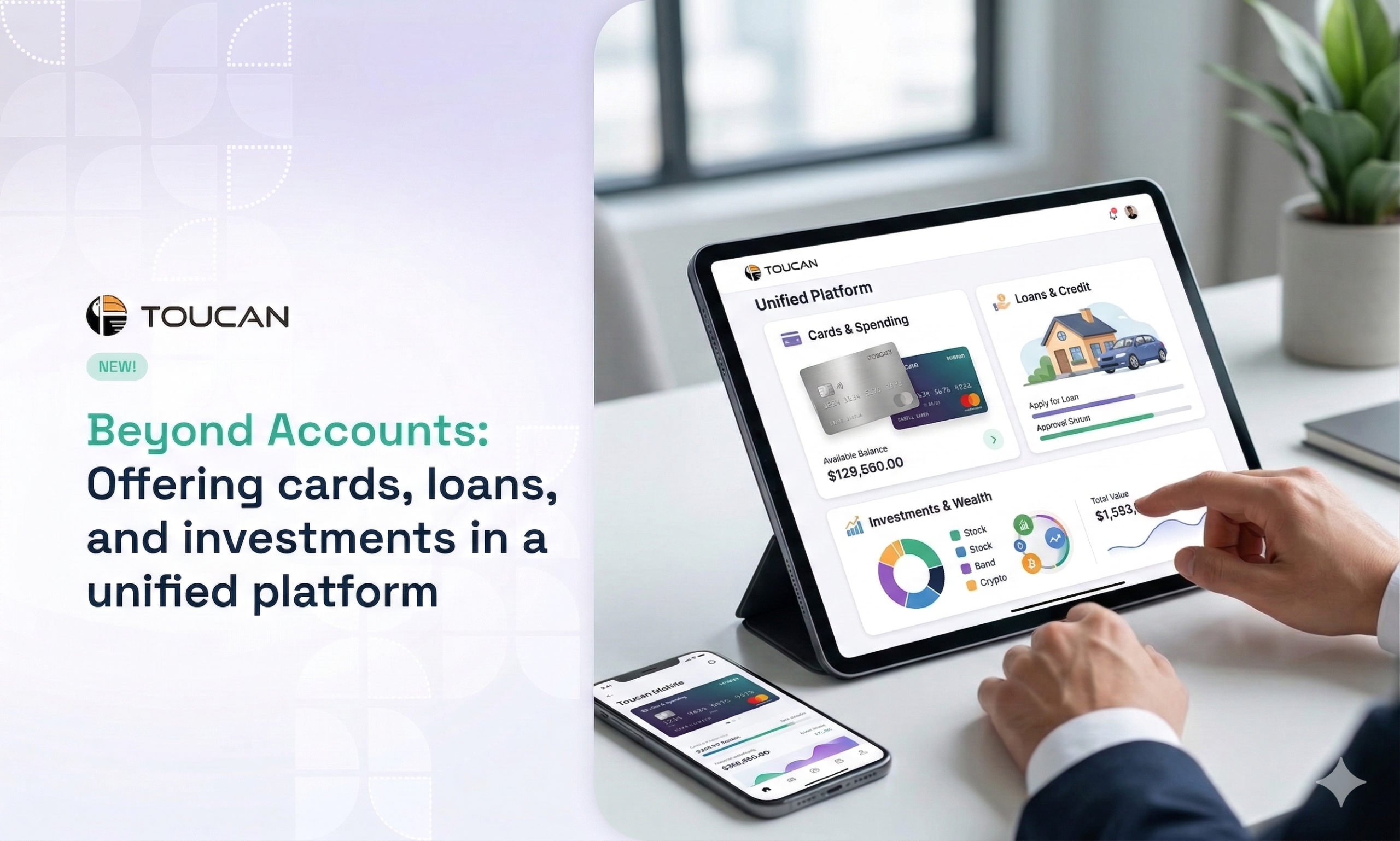
In a world where customers expect convenience, personalization, and speed, fintechs and banks are redefining what financial engagement looks like. Gone are the days when digital banking merely meant offering an online account or a payment app. The future belongs to unified financial platforms—solutions that seamlessly integrate accounts, cards, loans, and investment products into one cohesive experience.
The Shift from Banking to Financial Ecosystems
Traditional banks have long operated in silos: a savings account in one app, loan management through a different branch, investment services on yet another platform. Modern fintech players like Toucan are transforming this model with embedded finance, integrating multiple financial services into a single digital ecosystem.
This evolution allows users to move effortlessly between functions-checking balances, applying for credit, investing in digital funds, or managing payment cards, all within one interface. It’s not just about convenience; it’s about creating a frictionless financial journey that aligns with the user’s lifestyle.
The Unified Platform Advantage
A unified financial platform consolidates multiple financial services, from digital accounts and card issuing to loan management and investment access- into a single, modular technology layer.
The advantages ripple through the entire value chain:
For banks and fintechs, a unified platform dramatically reduces integration complexity. Instead of maintaining separate vendor relationships and tech stacks for cards, lending, and investment products, institutions can deploy and scale new offerings from a single API-first architecture.
For end customers, the impact is transformative. Imagine a single app where a user can check their account balance, manage their debit and credit cards, view their loan repayment schedule, and monitor their investment portfolio, all from one dashboard. A unified platform makes this possible, and it opens the door to intelligent cross-product features like dynamic spending insights, automated savings, and personalized credit recommendations based on a holistic view of the customer’s financial behaviour.
For regulators and compliance teams, a shared infrastructure means consistent KYC, AML, and fraud detection across all products, eliminating the gaps that often emerge when each service operates its own compliance silo.
The Technology That Makes It Possible
Building a true unified financial platform requires a fundamentally different architecture- one that is modular, API-first, cloud-native, and designed for composability.
Modular architecture allows financial institutions to deploy only the components they need today and add new products as demand grows, without reworking the underlying infrastructure. Need to add BNPL or virtual cards to your existing digital banking app? Plug in the module. Want to introduce micro-investments to your prepaid wallet users? Integrate the service through standardized APIs.
AI and machine learning play a critical role across the platform, from real-time fraud detection and intelligent transaction routing to automated credit scoring and personalized financial advice. By operating on a shared data layer across all products, AI models benefit from a 360-degree view of customer behaviour, producing more accurate predictions and recommendations.
Cloud-native infrastructure ensures the platform can scale to handle millions of transactions per day while maintaining the security and compliance standards demanded by regulators worldwide. PCI DSS, ISO 27001, and local regulatory certifications are no longer optional, they’re table stakes.
Open APIs and developer ecosystems enable third-party fintechs, merchants, and enterprise clients to embed financial services into their own platforms.
Why This Matters Now
Several macro trends are converging to make unified financial platforms not just desirable, but essential.
Consumer expectations have permanently shifted. Users want a single, coherent financial dashboard, not a collection of disconnected apps. As embedded finance turns everyday platforms into financial hubs, customers increasingly expect their fintech provider to offer more than just payments.
Regulatory evolution is pushing institutions toward greater transparency, interoperability, and data portability. Open finance frameworks expanding beyond payments to include pensions, investments, and insurance, are dissolving traditional product boundaries and rewarding platforms that can aggregate services seamlessly.
Competitive pressure is intensifying. Neobanks and super-app players are setting the pace with integrated financial experiences, forcing traditional institutions to modernize or risk losing market share. At the same time, B2B fintech infrastructure companies are making it easier than ever for non-banking platforms to embed financial services, creating competition from unexpected directions.
Economic efficiency demands it. In a climate where profitability matters more than growth at all costs, the operational efficiencies of a unified platform, shared compliance, reduced vendor sprawl, consolidated data, are a strategic imperative.
Toucan’s Vision for the Future
At Toucan, we believe financial experiences should be connected, intelligent, and inclusive. Our platform empowers businesses to move beyond simple account-based services and offer integrated solutions that combine payments, credit, and investments in one seamless ecosystem.
Ready to unify your financial product stack? Get in touch with the Toucan team to explore how ToucanOS can power your next-generation financial platform.
Frequently Asked Questions
Q1: What is a unified financial platform?
A: A unified financial platform is a digital infrastructure that brings accounts, cards, loans, and investments together in a single interface instead of separate, siloed systems.
Q2: How is this different from traditional digital banking?
A: Traditional digital banking usually digitises existing bank products like savings accounts and basic fund transfers, often with different systems for loans and cards. A unified platform connects deposits, lending, and card origination into one workflow, reducing operational complexity and improving cross‑sell and customer engagement.
Q3: Which types of businesses can benefit from a unified financial platform?
A: SaaS platforms, marketplaces, e‑commerce aggregators, gig‑economy networks, and B2B platforms can all embed financial services to deepen relationships with their users.
Q4: How does Toucan (Toucan) fit into this ecosystem?
A: A Toucan-style platform provides unified financial infrastructure so you can plug in payments, cards, lending, and investment modules through a single integration. It abstracts complexity across onboarding, KYC, risk, and settlement, allowing product and growth teams to focus on experience and monetisation rather than plumbing.