
Real-Time Cross-Border Payments: How Instant Rails and FPS Linkages Are Changing the Game
For decades, international money transfers have been synonymous with delays, high costs, and opacity. But the emergence of instant payment systems and their strategic interlinking is rewriting the rules of global finance, bringing real-time settlement capabilities to international transactions in ways previously unimaginable.
Traditional Cross-Border Payments: Key Pain Points
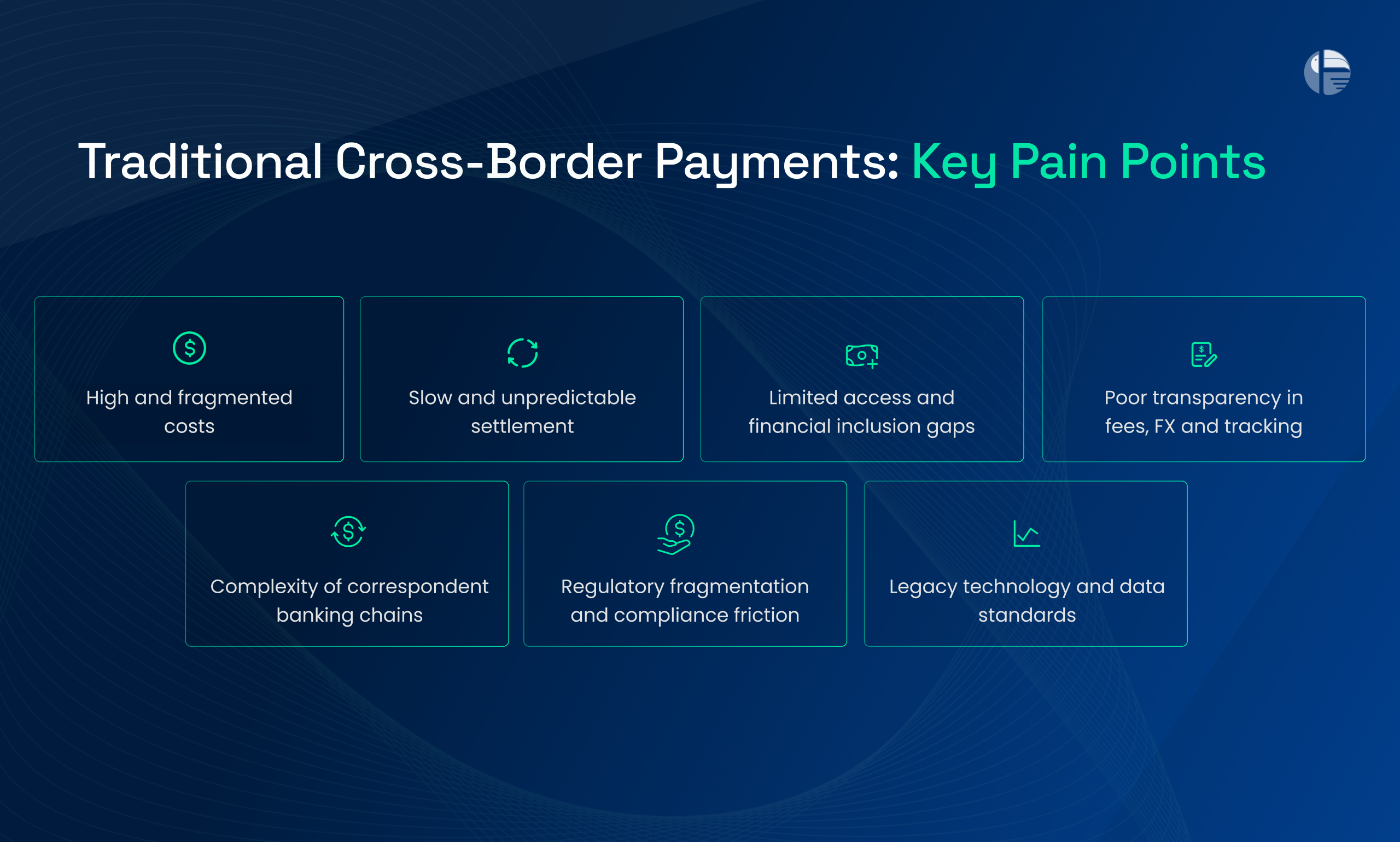
1. High and fragmented costs
- World Bank data show that the global average cost of sending a USD 200 remittance was around 5.79% in Q1 2024, with banks often charging more than 10–12% once all fees and spreads are included.
- Each intermediary bank in the correspondent chain adds processing fees, FX markups and compliance overhead, making end-to-end cost hard to predict and often uncompetitive compared with domestic instant payments.
2. Slow and unpredictable settlement
- Legacy cross-border rails are constrained by differing operating hours, batch processing windows and cut-off times across domestic RTGS/ACH systems, so even if a payment message moves fast, value transfer can still take 2–3 business days.
- Time-zone differences and manual exception handling mean that investigations or compliance reviews can extend settlement times further, increasing liquidity and counterparty risk for banks and corporates.
3. Limited access and financial inclusion gaps
- Many SMEs, micro-businesses and individuals in emerging markets still lack convenient access to electronic cross-border payment channels, either because they are unbanked or because local institutions have limited correspondent relationships.
- High compliance and onboarding costs make it unattractive for some providers to serve low-value or low-volume corridors, reinforcing financial exclusion and dependence on informal channels.
4. Poor transparency in fees, FX and tracking
- Users typically have limited visibility into how much a cross-border payment will cost end-to-end, what FX rate will be applied, which intermediaries will be involved, and when funds will arrive.
- Opaque FX spreads—where rates are marked up relative to wholesale interbank levels—often account for a significant share of total cost, but these spreads are rarely disclosed clearly to retail or SME customers.
5. Complexity of correspondent banking chains
- Traditional cross-border flows rely on multi-hop correspondent banking, where one or more intermediary banks hold nostro/vostro accounts and pass messages and funds along the chain.
- Each hop creates additional points of failure, adds reconciliation complexity, and increases the likelihood of delays when one participant applies extra checks or operates on different cut-off schedules.
6. Regulatory fragmentation and compliance friction
- Financial institutions must navigate inconsistent AML/CFT, sanctions, data protection and FX control regimes across jurisdictions, with different definitions of beneficial ownership and varying reporting requirements.
- This fragmentation leads to duplicated KYC, manual document collection, and frequent “false positives” in transaction screening, all of which slow down payments and raise operating costs.
7. Legacy technology and data standards
- Many cross-border payment flows still run on legacy messaging formats and batch-based infrastructures that were not designed for always-on, data-rich, API-first processing.
- Limited structured data in payment messages makes straight-through processing harder, increases manual repairs, and complicates compliance screening and reconciliation for banks and corporates.
Understanding Fast Payment Systems and Their Cross-Border Potential
Fast Payment Systems, or instant payment systems, enable funds to be transferred between accounts in seconds rather than days, operating 24/7/365. Unlike traditional payment methods that rely on batch processing and correspondent banking networks, FPS provide immediate settlement and confirmation to all parties involved.
Domestic instant payment systems (IPS/FPS) such as UPI in India, Faster Payments in the UK, and similar 24×7 real-time rails in other markets enable account-to-account transfers that clear and settle within seconds, often at near-zero marginal cost.
FPS linkages connect these national instant rails so that a payment initiated in one country can be routed via local real-time infrastructure to a beneficiary in another, reducing reliance on legacy cross-border rails.
Real-time cross-border Drivers
- Market Potential: The global cross-border payments market is already above USD 200 billion in annual revenues and is projected to grow to around USD 320–415 billion by 2030–2034, at roughly 7–7.1% CAGR, driven by e‑commerce, SME exports and remittances.
- For retail users and migrant workers, instant cross-border payments mean sending low-cost remittances with confirmation in seconds, instead of waiting days and incurring high spreads and opaque correspondent banking fees.
- For SMEs and digital businesses, FPS linkages enable near real-time settlement of cross-border receivables, improve cash-flow predictability, and reduce reconciliation friction thanks to richer, standardised payment data.
- Digital Innovation: The rise of Central Bank Digital Currencies (CBDCs), real-time payment (RTP) interlinking, and blockchain solutions are reducing reliance on traditional correspondent banking.
- ISO 20022 Adoption: The global rollout of this standardized messaging format is improving payment speed and transparency.
- E-commerce Expansion: Growing international retail demand is fuelling a surge in lower-value, higher-frequency C2B and B2C payments.
- The G20 programme stresses three priority themes for hitting its cross-border targets: payment system interoperability and extension, modernised legal/regulatory frameworks, and improved cross-border data exchange and message standards.
Benefits of Real Time Cross-border Payments
- Instant Settlement: Cross-border payments can settle in seconds rather than days, providing immediate access to funds for recipients.
- Cost Reduction: By bypassing multiple correspondent banking layers, FPS linkages dramatically reduce transaction costs. Project Nexus aims to keep transaction costs below 3% of the transfer value, aligning with UN Sustainable Development Goals.
- 24/7 Availability: Unlike traditional banking hours, instant payment systems operate continuously, enabling transactions at any time.
- Enhanced Transparency: Senders receive real-time confirmation and clear information about costs and payment status.
- Greater Financial Inclusion: Lower costs and easier access enable more people, particularly in emerging markets, to participate in the formal financial system.
Way Forward: The Path to Global Instant Payments
Several trends will shape the evolution of cross-border instant payments:
- Expanding Network Effects: Based on a survey by the Bank for International Settlements’ Committee on Payments and Market Infrastructures, 49% of instant payment systems surveyed are planning to establish initial or additional IPS links within the next two years.
- Blockchain Integration: In September 2025, SWIFT announced development of a blockchain-based digital ledger with over 30 banks to enable instant, always-on cross-border transactions while remaining interoperable with traditional correspondent banking.
- Open Banking Synergies: The ability to quickly and securely access bank accounts through Open Banking is increasing consumer instant payment transaction volume, with growth expected from 252 billion transactions in 2024 to over 600 billion by 2028.
- Regulatory Support: Governments recognize instant payments as infrastructure that can expand financial inclusion, support economic growth, and provide alternatives to dominant card networks while reducing cash dependence. For instance, initiatives like Project Nexus for cross-border FPS interlinking led by BIS and leading central banks like Reserve Bank of India (connecting UPI), Bank Negara Malaysia (connecting Real-time Retail Payments Platform), Bangko Sentral ng Pilipinas (connecting InstaPay), Monetary Authority of Singapore (connecting FAST), Bank of Thailand (connecting PromptPay),etc.
Conclusion
Real-time cross-border payments represent one of the most significant innovations in financial infrastructure in decades. The combination of domestic instant payment system maturity, technical standards like ISO 20022, multilateral platforms like Project Nexus, and strong regulatory support is converging to create genuine alternatives to traditional correspondent banking.
While challenges around governance, risk management, and technical integration remain, the trajectory is clear: instant cross-border payments are transitioning from pilot projects to production systems that will process trillions of dollars in transactions annually.
Power Your Cross-Border Payments with Toucan Payments
For Indian businesses managing international payments, Toucan Payment’s Cross-Border Payments Stack provides fast, transparent, and compliant transaction processing—serving SaaS providers, exporters, freelancers, and eCommerce businesses alike.
Ready to take your business global with seamless, compliant, and cost-effective payments? Explore Toucan Payment’s Cross-Border Payment Solutions today!
Frequently Asked Questions
Q1: What is the difference between FPS and traditional cross-border transfers?
A: Fast Payment Systems (FPS) settle transactions in seconds and operate 24/7/365, while traditional wire transfers can take 3-5 business days and only process during banking hours.
Q2: Are instant cross-border payments secure?
A: Yes, FPS linkages maintain high security standards through multiple layers of protection including encryption, authentication, real-time fraud monitoring, and regulatory oversight from central banks in participating countries.
Q3: How much do cross-border instant payments cost?
A: Costs vary by provider and corridor, but FPS linkages typically charge significantly less than traditional methods.
Q4: How does currency conversion work in cross-border instant payments?
A: Currency conversion typically occurs at the point of transaction using real-time exchange rates. The sender sees the exact amount that will be received in the destination currency before confirming the payment.
Q5: What is ISO 20022 and why is it important for cross-border payments?
A: ISO 20022 is a global messaging standard that provides a common language for financial institutions to exchange payment information. It allows different countries’ payment systems to communicate seamlessly by standardizing how payment data is structured and transmitted.